Do the Majority of the Children Coming in the Us Borders Come With Family or Alone
What differentiates Europeans from Americans: the cultural gap beyond the Atlantic
Written by Maciamo Hay (last updated in April 2018)
The Western world (i.e. Europe, the Americas, Commonwealth of australia and New Zealand) could be considered equally a unmarried "Western civilization". 'Westernness' could be defined past people who are ethnically or culturally European, in other words people of European descent or speaking a European linguistic communication as their female parent-tongue.
Europe itself has the greatest linguistic and cultural diversity of the Western world. However, the common history, geography and socio-political development of the European continent, as well as the cultural divergences that take occured in former colonies, have resulted in the creation of a mutual basis for European culture that dissimilarity (sometimes sharply) with the U.s.a. or the rest of the Western world.
Here is a summary of my observations on the differences between Europeans and Americans (United states). These are of course the major trends, and exceptions exist everywhere. Irish and Polish people, for case, tend to be closer to the American mainstream than to some of their boyfriend Europeans. Canadians are somewhere in between, sometimes more European, but frequently closer to their southern neighbours.
Feeling of time & distances
Our perception is shaped past our environment. A 100-year old house or church is considered new by Europeans, but old past Americans. I have even heard Americans call up that 200 years was 'ancient', a term that for Europeans usually refers to the Ancient World, i.eastward. the Antiquity, non antiques!
Perceptions are reversed when information technology comes to distances. Europeans would tend to think that driving 100 km is quite a long manner, while for Americans that would exist rather near. This is due to the much higher density of population in Europe, and the smaller size of Europe (believe information technology or not the European union is over twice smaller than the The states). Notwithstanding, Europeans travel much more than Americans, inside or outside their own continent. This might be because Europeans are used to go "abroad" since their childhood, European countries being comparatively so minor, which makes them more than comfy than Americans with the idea of travelling outside their land. Presumably, Seattle residents feel the aforementioned way nigh travelling to Canada, which lies simply across the edge.
Cars
Almost all Europeans have cars with transmission gears, while Americans accept a marked preference for automatic ones.
European cars are also very different in style than their American counterparts. American cars tend to be more massive and squarer, because size matters in the States. Americans have a fondness for (very) long limousines as well as choice-up trucks (in the countryside). Both are much rarer in Europe, hardly e'er seen in many regions. Europeans like rounder designs of cars. Smaller cars are much more than common in Europe, probably considering Europe has a more urbanised population and small cars are easier to park in cities, especially on pavements/sidewalks of historical cities, where large parking lots are rarer than in the USA.
Washing machines
European washing machines normally have only a cold water inlet (the water brought to acceptable temperature inside the machine) as opposed to both a hot and a common cold water inlet in the USA. European washing machines are almost ever loaded from the front, equally opposed to the top in the USA. Interestingly, Japan decided to follow the American system.
Measure System
All Europeans use the metric system (metres, grammes, litres, Celsius, etc.). Although Americans do learn information technology at school, the vast majority of them still use the old English Royal system (yards, miles, pounds, Fahrenheit, etc.) for everyday life.
Appointment and fourth dimension organization
Europeans write the date in the format "Day Calendar month Year", whereas Americans employ "Calendar month Day, Year". Americans usually consider that the calendar week starts on Sunday and ends on Sabbatum, while in Europe information technology always starts on Monday and finishes on Sunday.
Near non-English-speaking Europeans employ the 24h organization, as opposed to the 12h arrangement used in English-speaking countries.
Public holidays
The International Workers' Twenty-four hour period (a.k.a. Labour Solar day or May Day, on 1st May) is a national vacation in (near) European countries, merely not in the USA. European union countries as well celebrate Europe Day (5th or 9th May), although it is not an official holiday (all the same).
Social customs
Traditions like babe showers and bachelor(ette)'south night with strip-teasers originated in the U.s., and fifty-fifty though some made their manner to Europe, at to the lowest degree in some countries or social circles, they are still regarded every bit typically American. For near European this is something they only run across in American TV series and movies. The same is true of Thanksgiving and Halloween (although the latter has exported itself pretty successfully to Europe and East Asia from the belatedly 1990'south onwards). American marketing strategies have also given rising to nationwide phenomena like Black Friday and Cyber Monday, which, as potent as they are in the US, inappreciably have whatsoever equivalent in European countries (except on Amazon).
Schooling
Schools and universities are gratis in most European countries. Europeans see access to university every bit a right, while American families often take to save for years for their children to attend one. What is more than, universities in most countries around the world have entry exams, while only a few European countries practice (like the United kingdom).
North Americans take prom night at the end of the last academic year of high school (and sometimes also at the end of center school). It is a rather formal political party where boys article of clothing suits and come up accompanied with their date wearing evening dress. As American movies and series evidence, prom night is ofttimes a highlight in an American teenager's life. Europeans have no equivalent tradition, although informal end-of-studies parties are common (frequently several ones, which practise non necessarily accept place in the schoolhouse).
Languages
Foreign-language learning in Europe is now compulsory in every country since principal (unproblematic) school. Most Europeans learn 2 to 4 foreign languages, for obvious reasons. Americans commonly just speak English (+ their mother tongue for immigrants) considering they do not need more in their huge state.
Politics
Europeans tend to be more liberal regarding soft drugs, prostitution, booze, abortion, or cloning (but interestingly not so for GM nutrient). Americans on the contrary grant greater freedoms when information technology comes to gun possession, besides equally driving a car from a relatively immature historic period (14 to 16 years erstwhile, while the norm is 18 years former in Europe).
Authorities system
Americans have a "Congress", while Europeans all have "Parliaments".
American politcs is chiefly concise to two parties, which would be center-right and right, just lack influential left-wing or green parties. It is rare for a European country to have less than 3 main parties. Information technology is often iv or 5, which makes politics less bipolar (merely oftentimes also more than complicated to reach agreements).
The American police (FBI) is much more than "aggressive" than the police in Europe. Ccar chases, breaking into houses with guns shouting "police, don't motility, hands on your head !" or similar scenes are nearly not-existent in Europe. Suspects in the U.s.a. are detained more than easily and interrogated more than harshly. Americans also become to court much more promptly than in Europe.
The legality of guns in the States as well makes daily life and one's sense of safety completely dissimilar from Europe.
Patriotism
Americans put much more emphasis on patriotism than Europeans. Being a patriot is a way of life in the USA. The term is rarely used in Europe.
Few Europeans would mind rational critics of their state's government, while a proficient deal of Americans find them offensive or disrespectful (especially from non-Americans). Some Americans go as far as regarding criticism toward their government as a personal attack (although attitudes are starting to change). Europeans are only also happy to hear other people criticising their ain politicians or their country'south problems.
Religion
Americans are much more than religious than Europeans. Church going is very popular in the US, where it is seen as an indispensable way of socialising. In Europe the practise has almost entirely disappeared and is mostly limited to the elderly, or special events like weddings or Christmas.
God is often mentioned by American politicians, but almost never in Europe. Mixing organized religion and politics is taboo in many European countries (notably France), due to the stricter separation of state and faith. There are exceptions, such as Poland or Kingdom of spain, but even these countries do not appear very religious compared to the USA.
More than extremely, a majority of Americans would find offensive for someone to openly merits not to believe in god, whereas the opposite is often truthful in Europe.
Circumcision
Circumcision is almost unheard of in Europe, every bit in almost of the not-Muslim and non-Jewish world. The practise became very popular in the United states after WWII, and over 90% of babe boys built-in during the Cold War era (until the 1980's) were automatically circumcised, with or without their parents' consent. Information technology is becoming less common present. Nevertheless, a 2002 survey revealed that 79% of American men were circumcised. The prevalence was lower amid Hispanic men, and lowest of all in men born outside the United states of america.
Political correctness
Due to their groovy indigenous and religious diversity, Americans have developed a more acute sense of political correctness, in an attempt to attenuate frictions betwixt the diverse groups. Europeans however associate very much with their place of birth with their ethnicity, language and culture. In fact, until recently, adjectives for language, indigenous grouping and nationality would often match (with notable exceptions, like Belgium and Switzerland). In the United states of america (almost) everybody has the aforementioned nationality and language, and it is ethnicities and religions that differentiate people beginning, hence the greater importance for respect toward other ethnicities and religions in the United states.
In Europe the emphasis of respect is put on cultures and languages. Making aggressive jokes well-nigh a particular linguistic or cultural group (e.g. calling the French "cheese-eating monkeys") considering of the importance of cheese in French culture), for case, is the equivalent of attacking a item ethnic or religious grouping in the US. It's a large no-no. Nonetheless, making fun of religions is usually quite adequate in Europe.
Socialising rules
There is a cultural trend for Americans, and New Earth people in full general (Americas, Australia) to be more open, friendly, helpful, but too hypocritical toward strangers, compared to the more reserved and blunt Europeans. That phenomenon was observed by many cultural psychologists. The likely reason is that societies in the New World were built on immigration and people are more often than not more mobile and very likely to meet people from different ethnic, religious and cultural backgrounds. In such a various environment it is helpful to be open and sociable to create new connections, as immigrants had to start a new life from nothing and fit with a wide range of different people. But information technology is besides a adept idea to continue your beliefs and convictions to yourself to avoid shocking or pain other people's sensitivities, as it'due south harder to know what people retrieve and feel in a multicultural environment than in a homogeneous rural community in Europe. Americans are famed for this well-meaning habit of not telling everything we think and expressing everything nosotros feel in order to avoid conflicts or to avoid unnecessary disagreements. Europeans instead aren't as a whole that afraid of expressing themselves and of existence nice to others simply if and when they actually feel like (not because that's the polite affair to practice). They weren't culturally taught to salvage face past adjusting their beliefs to not annoy other people. Instead they value their self-expression, self-esteem and indivituality above even things like social peace, good relations with neighbors and mates and their social face. One could say that Americans value more than conjuration, while Europeans favour outspokenness. American political definiteness is a result of this cultural propensity to agreeableness. The Brits are an exception as they fit somewhere in betwixt Americans and continental Europeans. They may be fifty-fifty more than reserved than the European boilerplate, but their generally polite and friendly attitude makes them much less blunt than the majority of Europeans.
Food
Europeans all take many traditional dishes too as regional culinary specialties. Specialities tend to be very local, so that some pastries can exist seen in one town, but non 100 km abroad.
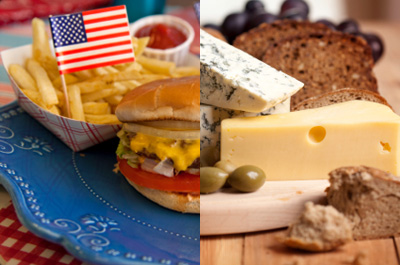
Europeans eat more varied and balanced meals (especially in southern cultures) and less fast food than Americans (except maybe the Brits). Europeans eat more cheese (not only the French !), more yoghurts, and on boilerplate drink more wine and stronger beers than Americans.
Americans consume sweeter food and much more than soft drinks than Europeans. American alcohol laws are much tougher than anywhere in Europe (see map of legal age to drink alcohol in Europe). It is generally prohibited to potable booze before the historic period of 21 in the Us, even with 1'southward parents' aurorization. Age controls are both more common and more severely punished in the United States than in Europe.
Sports
It is interesting how the popularity of sports can be and so different between Europe and North America. The most popular sports in ALL Europe is football (soccer), probably followed by tennis, cycling, and Formula ane (besides as other motor races). In the US, soccer and F1 are far away in the popularity ranking. It is baseball, basketball, ice hockey and American football that attract the crowds and make money. And every bit much as European sports lack popularity in the US, the reverse is true (except for basketball).
Advert
Advertisement practices vary profoundly between Europe and Due north America (especially in the Usa). While it is common to run across people wearing inflatable costumes to promote products on American streets, information technology is very rare or never observed in most European countries. Likewise, Americans similar to place giant billboards along highways/motorways, this practice is absent (usually illegal considering too distracting) in most of Europe, where the only signs are public awareness campaigns for safer driving.
Street names
Street naming practices vary between countries and cities. But one of them, attributing numbers to the streets (e.g. 5th Avenue or 16th Street) instead of names, is typically North American. This exercise is most unheard of in Europe, where streets either have a proper noun or, in rare cases for isolated land roads, nil. All roads exterior cities are obviously part of a numbering scheme both in Europe and Due north America, but those come on top of the street names. For example, the A40 betwixt London and Oxford is known as Oxford Road in the Greater London, and London Road beyond that. It is customary in nigh European countries to proper name a road connecting cities according to the proper name of the city to which it leads. This custom is occasionally found in the Us, notably in New England, but never every bit systematic as in Europe. The only exception in Europe are motorways (AmE: highways), which are non named anywhere, although they generally have two numbers: a national one (e.g. A1 or M25) and a European one complying with the United Nations's International E-route network (e.g. E15 or E60).
Naming practices
Americans are peradventure the only people in the world who have taken the habit to utilize surnames equally given names, and this trend is getting increasingly popular. These are names like Jackson, Cooper, Harrison, Mason, Jenson, Austin, Sheldon, Tyler, Riley, Dylan, Bradley, Roy... They are mostly boy names, but girls aren't immune either. Taylor, Cameron, Mckenzie, Addison and Maddison are simply a few examples. This practise was originally used mostly for middle names (every bit in John Fitzgerald Kennedy, or William Jefferson Clinton), but has become widely used for first names since the second one-half of the 20th century.
Dating & Union
While marriage is increasingly seen as a completely optional "folkloric tradition" in Europe, it is still quite important in the The states (probably because organized religion is also more of import in that location). Statistically Americans ally much more than Europeans, only also divorce more. Gay marriage, now legal in several EU countries and inappreciably an outcome for argue in Europe (because of the little importance of spousal relationship in Europe present), is still vehemently opposed past a big function of the Us population.
Hymeneals ceremonies are likewise much more important and formal in the U.s.. In most of Europe it is limited to an informal family gathering (usually at the helpmate or groom's parental home). Union traditions exercise vary considerably between European countries, and even more than between families. But in boilerplate information technology is certainly less important than in u.s.a. (or in Asian countries for that matter).
Furthermore, there are some potent nationwide American traditions regarding wedding ceremony ceremonies, similar bringing "something old, something new, something borrowed, and something blueish". In that location is obviously no equivalent thing at a European level.
In fact, even the way of dating tends to follow so well-divers rules in the USA. For instance, there are widely followed conventions about sleeping on the tertiary appointment. Men know they shouldn't await to see a woman again if she insists to split the bill ("check" in AmE) at the end of their first engagement. The way to suggest (the staging), or the act of buying an expensive date ring (often respective to 1 or several months of bacon!) are, in general, more important to Americans than Europeans. In Europe, the way of doing things is more informal and spontaneous, and tin varies a lot from one region to some other, and even on a person to person basis. Sometimes, that makes Europeans envious of how like shooting fish in a barrel and clear things wait in the U.s. in comparison. The drawback is that it seems besides stereotypical, peculiarly if yous don't like the conventions.
Another major departure is that in in Europe, contrarily to the US, priests/ministers do non have the legal power to marry people (except in Italy). An American couple tin ask a friend who has been ordained online to marry them, simply that isn't possible in Europe (including Italia). Likewise, "eloping" to get married (due east.thou. in Vegas) is also a typically American thing since hardly anyone elopes to get married at a town hall.
In the Usa having children out-of-union has a bad rep because the vast majority of these children end upward living in single-parent homes. But 2% of American children live in a family with two cohabiting parents (as opposed to two married parents or a single parent), confronting 31% in Estonia, 26% in Sweden, 25% in French republic, 18% in Kingdom of belgium and fourteen% in the United kingdom of great britain and northern ireland. Even traditional minded (and relatively religious) Germans and Spaniards have 8% of them (iv times more than in the Usa !). => see also: Faith and tradition nevertheless influence couples' decision to get married
Nobility
Europe still has a form of noble people (restored in Eastern Europe afterwards the autumn of communism), and many countries volition mention the championship (e.g. Baron) in official documents. About 1% of family names however have a "noble particle" (uncapitalised "de", "di", "von", "van", etc.) and it does have a meaning for some people. Europe too has hundreds of thousands of castles reminding people on a nearly daily ground of the fourth dimension where dignity one time ruled over everything.
Armed services politics
It is prohibited in most of Europe for the military people, or anyone with a professional military history to become a pol. This means that they become politically ineligible. In the Usa, the reverse is near true. It is almost required to have a armed services history to get president, and quite a few Congress people accept likewise served in the army. Maybe this is because the president's image is all the same strongly associated with that of the "commander in chief", and because defence (or offence) is and then of import in The states politics.
Bumper stickers
Bumper stickers can be commercial, religious, political, sports, humorous or philosophical, merely they are substantially an American phenomenon. Europeans are much more reserved when information technology comes to sticking things on their cars, and the usage is more often than not limited to 'baby on board' stickers, every bit well as national or regional flags or logos (e.thousand. in Spain where the black bull sticker is ubiquitous, except in Catalonia where its a blackness donkey or in Asturias where it is the Astur-leonese cross). Humorous stickers are very occasionally seen in Europe, while religious, political or commercial ones are virtually non existent.
Follow-upward
Discuss this article on the Eupedia Forum
Source: https://www.eupedia.com/europe/cultural_differences_europe_usa.shtml
0 Response to "Do the Majority of the Children Coming in the Us Borders Come With Family or Alone"
Postar um comentário