Do You Know What a Penny Looks Like
| United States | |
| Value | 0.01 U.S. dollar |
|---|---|
| Mass | (1982-nowadays) 2.5 g (0.08 troy oz) |
| Diameter | 19.05 mm (0.75 in) |
| Thickness | i.52 mm (0.0598 in) |
| Edge | Plain |
| Composition | (1982–present) copper-plated zinc 97.5% Zn, 2.five% Cu |
| Years of minting | 1793–1814, 1816–present |
| Catalog number | – |
| Obverse | |
 | |
| Design | Abraham Lincoln |
| Designer | Victor D. Brenner |
| Design date | 1909 (modified since) |
| Contrary | |
| Design | Wedlock Shield |
| Designer | Lyndall Bass |
| Design date | 2010–nowadays |
The The states one-cent coin (symbol: ¢), often called the "penny", is a unit of measurement of currency equaling one one-hundredth of a United States dollar. It has been the lowest confront-value physical unit of U.S. currency since the abolition of the half-cent in 1857 (the abstract manufactory, which has never been minted, equal to a 10th of a cent, continues to see express use in the fields of revenue enhancement and finance). The first U.Southward. cent was produced in 1787, and the cent has been issued primarily every bit a copper or copper-plated coin throughout its history.
The penny is issued in its current class every bit the Lincoln cent, with its obverse featuring the profile of President Abraham Lincoln since 1909, the centennial of his nascence. From 1959 (the sesquicentennial of Lincoln's nascency) to 2008, the opposite featured the Lincoln Memorial. Iv unlike reverse designs in 2009 honored Lincoln'southward 200th birthday and a new, "permanent" contrary – the Union Shield – was introduced in 2010. The coin is 0.75 inches (19.05 mm) in diameter and 0.0598 inches (1.52 mm) in thickness. The current copper-plated zinc cent issued since 1982 weighs 2.five grams, while the previous 95% copper cent notwithstanding plant in circulation weighed iii.11 m (see farther beneath).
The U.S. Mint'south official name for the coin is "cent"[i] and the U.Southward. Treasury's official name is "ane cent piece".[2] The colloquial term penny derives from the British coin of the same name, which occupies a like place in the British system. Pennies is the plural grade (non to be confused with pence, which refers to the unit of measurement of currency).
In the early 2010s the toll of metal used to make pennies rose to a noticeable cost to the mint which peaked at more than than $0.02, a negative seigniorage, for the $0.01 face up-value coin. This pushed the mint to look for alternative metals again for the coin, and also brought the fence about eliminating the coin into more focus. Every bit of 2022[update] there are no business firm plans to exercise then.[3]
History of composition [edit]
The composition of the penny has varied over time:[4] [5]
| Years | Material | Weight (grains) | Weight (grams) |
|---|---|---|---|
| 1793–1795 | ~100% copper | 208 grains | xiii.48 |
| 1795–1857 † | ~100% copper | 168 grains | 10.89 |
| 1856–1864 | 88% copper, 12% nickel (likewise known as NS-12) | 72 grains | 4.67 |
| 1864–1942 | bronze (95% copper, 5% tin can and zinc) | 48 grains | iii.eleven |
| 1943 | zinc-coated steel (also known as 1943 steel cent) | 42 grains | 2.72 |
| 1944–1946 | gilding metal (95% copper, 5% zinc) | 48 grains | 3.11 |
| 1947–1962 | bronze (95% copper, 5% can and zinc) | 48 grains | three.11 |
| 1962 – September 1982 | gilding metal (95% copper, 5% zinc) | 48 grains | 3.11 |
| October 1982 – present | copper-plated zinc (97.5% zinc, 2.five% copper) | 38.six grains | 2.5 |
The isotope composition of early on coins spanning the period 1828 to 1843 reflects the copper from Cornish ores from England, while coins after 1850 reverberate the Keweenaw Peninsula, Michigan ores, a finding consistent with historical records.[vi]
In 1943, at the peak of World War Ii, zinc-coated steel cents were made for a brusk fourth dimension because of state of war demands for copper. A few copper cents from 1943 were produced from 1942 planchets remaining in the bins. Similarly, some 1944 steel cents have been confirmed. From 1944 to 1946, salvaged ammunition shells made their fashion into the minting procedure, and it was not uncommon to see coins featuring streaks of brass or having a considerably darker finish than other issues.
During the early 1970s, the price of copper rose to the point where the cent contained nigh one cent's worth of copper. This led the Mint to exam alternative metals, including aluminum and bronze-clad steel. Aluminum was chosen, and over 1.5 million samples of the 1974 aluminum cent were struck before ultimately being rejected.
The cent's composition was changed in 1982 because the value of the copper in the money started to ascension above one cent.[7] Some 1982 cents used the 97.5% zinc composition, while others used the 95% copper composition. With the exception of 2009 bicentennial cents minted specifically for collectors, United states cents minted subsequently 1982 take been zinc with copper plating. The bronze and copper cents can be distinguished from the newer zinc cents by dropping the coins on a solid surface. The predominantly zinc coins make a lower-pitched "clunk", while the copper coins produce a higher-pitched ringing sound.[viii] In addition, a total 50-cent roll of pre-1982/3 coins weighs 5.4 oz (150 thousand) compared to a mail-1982–83 roll which weighs 4.4 oz (120 g).
Designs [edit]
The coin has gone through several designs over its 2-hundred-year time frame. Until 1857 it was virtually the size of the current U.S. dollar coins (Susan B. Anthony through present dollars). Shown below are the dissimilar cent designs that have been produced; mintage figures tin be found at Usa cent mintage figures.
Large cents:
- Flowing Hair Chain 1793
- Flowing Hair Wreath 1793
- Liberty Cap 1793–1796
- Draped bust 1796–1807
- Classic Caput 1808–1814
- Coronet 1816–1839
- Braided Hair 1839–1857, 1868 (non a regular result)
Minor cents:
- Flying Eagle cent (1856–1858)
- Indian Head cent (1859–1909)
- Lincoln cent (1909–present)
- Lincoln Wheat (1909–1958)
- Lincoln Memorial (1959–2008)
- Lincoln Bicentennial 4 reverse designs (2009)
- Lincoln Spousal relationship Shield[9] (2010–present)
Throughout its history, the Lincoln cent has featured several typefaces for the date, but near of the digits accept been old-manner numerals, except with the 4 and 8 neither ascending nor descending. The merely meaning deviation is that the small 3 was non-descending (the same size as a 0, one, or two) in the early history, before switching to a descending, large 3 for the yr 1934 and so permanently (equally of 2014[update]) in 1943. Similarly, the digit 5 was small and non-descending up to 1945.
-
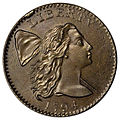
Freedom Cap cent, 1794
-

Classic Head cent, 1811
-

Braided Pilus large cent, 1850
-

Flying Eagle pocket-sized cent, 1858
-
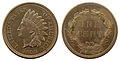
Indian Caput cent, 1859
Lincoln cent [edit]
-

-

Obverse side of a cent afterward 17 years of circulation
The Lincoln cent is the current ane-cent coin of the U.S. It was adopted in 1909 (which would have been Lincoln's 100th birthday), replacing the Indian Caput cent. Its opposite was changed in 1959 from a wheat-stalks design to a design which includes the Lincoln Memorial (to commemorate Lincoln's sesquicentennial) and was replaced again in 2009 with four new designs to commemorate Lincoln's bicentennial. There are more one-cent coins produced than any other denomination, which makes the Lincoln cent a familiar item. In its lifespan, this coin has weathered both world wars, one of which temporarily changed its composition as part of the state of war effort. The obverse design is the longest produced for any circulating American coin.
History [edit]
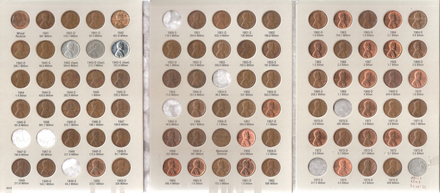
A collection of Lincoln cents from 1941 to 1974. Nearly complete prepare in a folder. Too features two error coins.

Wheat (1909–1958)

Lincoln Memorial (1959–2008)
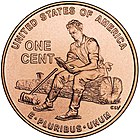
Determinative Years in Indiana (Lincoln Bicentennial, 2009)
When the Lincoln one-cent money made its initial appearance in 1909, information technology marked a radical divergence from the accustomed styling of United States coinage, equally it was the showtime regular coin to carry a portrait other than the mythical Liberty which appeared on most pre-1909 regular coins. Previously, a potent feeling had prevailed against using portraits on coins in the Us, merely public sentiment stemming from the 100th anniversary celebration of Abraham Lincoln's birth proved stronger than the long-standing tradition.
A diverseness of privately minted tokens bearing Lincoln'due south image circulated as 1-cent pieces during Lincoln's presidency; legitimate coinage had go scarce during the Civil State of war. These early on tokens undoubtedly influenced the denomination, appearance, size, and composition of Lincoln cents.
Theodore Roosevelt, the 26th U.S. president, thought American coins were so common and uninspiring that he attempted to become the motto "In God We Trust" removed equally offending religion. Roosevelt had the opportunity to pose for a young Lithuanian-born Jew, Victor David Brenner, who, since arriving nineteen years earlier in the United States had become i of the nation's premier medalists. Roosevelt had learned of Brenner'south talents in a settlement house on New York City'due south Lower Eastward Side and was immediately impressed with a bas-relief that Brenner had made of Lincoln, based on a Mathew Brady photograph. Roosevelt, who considered Lincoln the savior of the Union and the greatest Republican president, and who also considered himself Lincoln'southward political heir, ordered the new Lincoln cent to be based on Brenner's piece of work and to exist released but in fourth dimension to commemorate Lincoln's 100th birthday in 1909. The likeness of President Lincoln on the obverse of the coin is an adaptation of a plaque Brenner created several years before which had come to the attention of President Roosevelt in New York.[10]
In addition to the prescribed elements on U.S. coins—Liberty and the appointment—the motto In God Nosotros Trust appeared for the first time on a money of this denomination. The United states Congress passed the Act of March 3, 1865, authorizing the employ of this motto on U.S. coins,[11] during Lincoln's tenure in office.
Even though no legislation was required for the new design, approving of the Secretary of the Treasury was necessary to make the alter. Franklin MacVeagh gave his approval on July 14, 1909, and non quite iii weeks later on, on Baronial two, the new money was released to the public.
In 1918, later the controversy over Brenner's name and initials on the reverse had died down, his initials were placed on the obverse with no farther controversy. They are to exist establish in minute form on the rim of the bust, only nether the shoulder of Lincoln.
Wheat cent (1909–1958) [edit]
A study of 3 potential reverses resulted in the approving of a very unproblematic blueprint bearing two wheatheads in memorial fashion. Between these, in the center of the coin, are the denomination and United states of america, while curving effectually the upper border is the national motto, E Pluribus Unum, Latin for "Out of Many, I".
The original model bore Brenner's name on the reverse, curving along the rim beneath Usa OF AMERICA. Earlier the coins were issued, all the same, the initials "VDB" were substituted considering officials at the United states Mint felt the name was besides prominent. Subsequently the coin was released, many protested that fifty-fifty the initials were conspicuous and detracted from the design. Considering the coin was in cracking demand, and because to brand a change would accept required halting production, the decision was made to eliminate the initials entirely.
Thus in 1909 the U.Due south. had vi different cents: the 1909 and 1909-S Indian Head cents, and four Lincoln coins: 1909 VDB, 1909-S VDB, 1909 and 1909-Southward. In all cases the Philadelphia mintages far exceeded the San Francisco issues. While the smallest mintage is the '09-S Indian, the '09-S VDB is the key Lincoln appointment, and hence is nearly valuable. Its mintage of 484,000 is only ane.seven% of the plain 5.D.B.
Lincoln Memorial cent (1959–2008) [edit]

Detail of reverse showing Lincoln statue inside the memorial
On February 12, 1959, a revised reverse design was introduced as part of the 150th anniversary of Lincoln'south birth. No formal competition was held. Frank Gasparro, and then Assistant Engraver at the Philadelphia Mint, prepared the winning entry, selected from a group of 23 models that the engraving staff at the Mint had been asked to present for consideration. Again, only the approving of the Secretary of the Treasury was necessary to make the change considering the design had been in apply for more than than the required 25 years. The imposing marble Lincoln Memorial provides the cardinal motif, with the legends E Pluribus Unum and U.s. OF AMERICA completing the design, together with the denomination. The initials "FG" appear on the right, near the shrubbery. This series is noteworthy for having the image of Abraham Lincoln both on the obverse and reverse, as his likeness can exist discerned at the center of the memorial on the contrary.
Lincoln Bicentennial cents (2009) [edit]
The Presidential $ane Coin Act of 2005 required that the cent'due south reverse be redesigned in 2009. This resulted in the mintage of four dissimilar coins showing scenes from Abraham Lincoln's life in accolade of the bicentennial of his nativity.
These four designs, unveiled September 22, 2008 at a ceremony held at the Lincoln Memorial on the National Mall in Washington, D.C., are:
- Birth and early on babyhood in Kentucky: this design features a log cabin and Lincoln's nascence year 1809. It was designed by Richard Masters and sculpted by Jim Licaretz. This cent was released into circulation on Lincoln'south 200th birthday, Feb 12, 2009, at a special ceremony at LaRue County High Schoolhouse in Hodgenville, Kentucky, Lincoln'south birthplace.[12] The mintage was extremely low compared to prior years (see Lincoln cent mintage figures). It has been nicknamed the "Log Cabin Penny".
- Formative years in Indiana: this design features a young Lincoln reading while taking a break from runway splitting. It was designed and sculpted by Charles Vickers. Nicknamed the "Indiana Penny", it was released on May fourteen, 2009.[xiii]
- Professional person life in Illinois: this pattern features a young professional Lincoln continuing before the Illinois State Capitol, in Springfield. It was designed by Joel Iskowitz and sculpted past Don Everhart. Nicknamed the "Illinois Penny", it was released on August 13, 2009.[13]
- Presidency in Washington, D.C.: this design features the half-completed Capitol dome. It was designed by Susan Gamble and sculpted past Joseph Menna. This fourth cent was released to the public on November 12, 2009.[xiii] U.S. Mint released collector'southward sets containing this design in copper prior to the public launch of this pattern in zinc.
Special 2009 cents struck for auction in sets to collectors had the metal copper content of cents minted in 1909 (95% copper, 5% tin can and zinc).[14] Those struck for circulation retained the normal composition of a zinc cadre coated with copper.
Wedlock shield cent (2010–present) [edit]
The 2005 act that authorized the redesign for the Bicentennial stated that some other redesigned contrary for the Lincoln cent will exist minted which "shall bear an paradigm emblematic of President Lincoln'southward preservation of the The states of America equally a unmarried and united state".[15] Xviii designs were proposed for the reverse of the 2010 cent.[16] On April 16, 2009 the Committee of Fine Arts (CFA) met and selected a design that showed xiii wheat sheaves jump together with a ring symbolizing American unity every bit one nation.[17] Later on this blueprint was withdrawn because it was similar to coinage issued in Deutschland in the 1920s.[xviii] The Citizens Coinage Advisory Committee later met and chose a blueprint showing a Union shield with One CENT superimposed in a whorl; E Pluribus Unum was as well depicted in the upper portion of the shield.[xviii] [19] In June 2009 the CFA met again and chose a design featuring a modernistic rendition of the American flag.[20] As a role of the release ceremony for the final of the 2009 cents on Nov 12, the design for the 2010 cent was announced.[21] The blueprint chosen was the one that was chosen before by the CCAC.[21] Co-ordinate to the Mint, the thirteen stripes on the shield "represent the states joined in 1 meaty union to back up the Federal regime, represented by the horizontal bar above".[22] The Mint also noted that a shield was unremarkably used in paintings in the Capitol hallways painted by Constantino Brumidi, an artist in the Capitol active during the Lincoln Presidency.[22] The obverse of the cent was also changed to a modern rendition of Brenner'southward design.[23] [21] The new Union Shield design replaces the Lincoln memorial in use since 1959.[21] The coin was designed by artist Lyndall Bass and sculpted by U.S. Mint sculptor-engraver Joseph Menna.[24] In January 2010, the coins were released early in Puerto Rico;[25] this was caused by a shortage of 2009-dated pennies on the island.[23] The new design was released at a anniversary at the Abraham Lincoln Presidential Library in Springfield, Illinois on February eleven, 2010.[26] In 2017, cents minted in Philadelphia were struck with a "P" mintmark to celebrate the 225th anniversary of the U.S. Mint. 2017 is the simply year that Philadelphia cents have had a mintmark.[27]
Production issues [edit]
Proposals to eliminate [edit]
It has been suggested that the cent should be eliminated as a unit of measurement of currency for several reasons including that many Americans do not actually spend them, but rather only receive them in modify at stores and proceed to render them to a banking company for college denomination currencies, or greenbacks them in at coin counting kiosks. About modernistic vending machines do not take pennies, further diminishing their utility, and the production price (figured in U.S. Dollars) now exceeds the face up value of the coin, acquired past increasing aggrandizement.[28] In 2001 and 2006, for example, U.s. Representative Jim Kolbe (R) of Arizona introduced bills which would have stopped product of pennies (in 2001, the Legal Tender Modernization Human activity, and in 2006, the Currency Overhaul for an Industrious Nation [COIN] Act).[29]
In anticipation of the business of melting downwardly U.S. pennies and U.South. nickels for profit, the U.S. Mint, which is a function of the US Department of the Treasury, implemented new regulations[30] on December fourteen, 2006, which criminalize the melting of pennies and nickels and place limits on export of the coins. Violators tin be punished with a fine of upwardly to $ten,000 USD and/or imprisoned for a maximum of five years.[31]
Metal content and manufacturing costs [edit]
The price of metal drives the cost to manufacture a cent. The Secretarial assistant of the Treasury has authority to alter the pct of copper and zinc in the one-cent coin if needed due to cost fluctuations.[32] For years, the Mint'due south production and aircraft costs for cents have exceeded the face up value of the coin (the Mint's fixed costs and overhead, however, are captivated by other circulating coins).[33] As a issue, the U.S. Treasury loses millions of dollars every year producing cents. For instance, the loss in 2013 was $55 one thousand thousand.[34]
| Financial year | 2010 [32] | 2011 | 2012[35] | 2013 [34] | 2014 [36] | 2015 [37] | 2016 [38] | 2017 | 2018 [39] | 2019 [forty] |
|---|---|---|---|---|---|---|---|---|---|---|
| Price (cents) | 1.79 | ii.41 | ii.00 | one.83 | 1.70 | i.67 | ane.50 | 1.82 | 2.06 | 1.99 |
When copper reached a record loftier in February 2011,[41] the cook value of a 95% copper cent was more three times its confront value. Every bit of January 21, 2014, a pre-1982 cent contained 2.203 cents' worth of copper and zinc, making it an attractive target for melting by people wanting to sell the metals for profit. In comparison, postal service-1982 copper-plated zinc cents have a metallurgical value of only 0.552 cent.[42]
Toxicity [edit]
Zinc, a major component of U.S. cents minted later mid-1982, is toxic in big quantities. Swallowing such a money, which is 97.five% zinc, can cause damage to the stomach lining considering of the high solubility of the zinc ion in the acidic stomach.[43] Coins are the nearly commonly ingested strange body in children just generally are allowed to laissez passer spontaneously unless the patient is symptomatic.[44] Zinc toxicity, mostly in the form of the ingestion of U.S. pennies minted afterwards 1982, is commonly fatal in dogs where it causes a severe hemolytic anemia.[45] It is besides highly toxic in pet parrots and tin ofttimes be fatal.[46]
See also [edit]
- 1909-S VDB Lincoln Cent
- 1943 steel cent
- 1955 doubled-dice cent
- 1974 aluminum cent
- Large cent (Us coin)
- Legal Tender Modernization Human action
- Mill (currency)
- Penny (Canadian coin)
- Penny debate in the United States
- Ring cent
- Take a penny, leave a penny
- United States Mint coin production
- Lincoln cent mintage figures
References [edit]
- ^ "The United States Mint Coin Specifications". Washington, D.C.: United States Mint. Retrieved 2009-11-09 .
Denomination:Cent; Nickel; Dime; Quarter Dollar.... (categories across the acme of the specifications chart)
- ^ "Denominations". Washington, D.C.: Us Department of the Treasury. Retrieved 2015-03-03 .
The proper term is "1 cent slice," merely in common usage this coins is often referred to as a penny or cent.
- ^ Nicks, Denver (2016-04-20). "Go Rid of the Penny? Treasury Secretarial assistant Jacob Lew Says Yep | Money". Time.com. Archived from the original on April 24, 2016. Retrieved 2018-04-24 .
- ^ "Coin Specifications". Retrieved 2019-03-23 .
- ^ U.S. Mint (3 September 2019). "Coin Production". Retrieved 2020-12-20 .
- ^ Mathur, R (2009). "The history of the U.s.a. cent revealed through copper isotope fractionation". Journal of Archaeological Science. 36 (2): 430–433. doi:ten.1016/j.jas.2008.09.029.
- ^ "1982 Lincoln Memorial Cents". Coins.thefuntimesguide.com. Retrieved 2011-07-twenty .
- ^ "Is my Penny a Copper, or a Zinc Cent?". Retrieved 2008-06-sixteen .
- ^ "The United States Mint Coins and Medals Program". USMint.gov. Retrieved 2010-12-27 .
- ^ Margolick, David (2007-02-11). "Penny Foolish". The New York Times . Retrieved 2010-05-22 .
- ^ "History of 'In God We Trust'". treasury.gov . Retrieved 2016-04-29 .
- ^ Kocher, Greg (February 13, 2009). "Lincoln's birthplace is launch site for new penny". Lexington Herald-Leader.
- ^ a b c O'Keefe, Ed (February 17, 2009). "Heads Abe, Tails New On Pennies Marker Lincoln Bicentennial". The Washington Post. p. A11.
- ^ "U.S. Mint Online Product Itemize". Itemize.usmint.gov. Retrieved 2011-07-xx .
- ^ Pub.L. 109–145 (text) (PDF), 119 Stat. 2674, enacted Dec 22, 2005 – Presidential $1 Coin Act of 2005, Title Vi, §303. "The design on the reverse of the 1-cent coins issued after December 31, 2009, shall bear an image emblematic of President Lincoln's preservation of U.s. of America equally a single and united state." Retrieved 2009-xi-30.
- ^ Staff (2009-06-09). "2010 Lincoln Cent Design Proposals". 2010 Lincoln Cents. Retrieved 2009-11-30 .
At that place were initially 18 design proposals for the 2010 Lincoln Cent reverse.
- ^ McAllister, Nib (2009-05-04). "Wheat Design may appear on the 2010 cent". Coin World. 50 (2560): ane.
- ^ a b McAllister, Pecker (2009-05-18). "Mint withdraws 2010 'Wheat' cent pattern". Money World. l (2562): i.
- ^ McAllister, Beak (2009-05-18). "Mint withdraws 2010 'Wheat' cent design". Coin World. 50 (2562): 1.
- ^ McAllister, Bill (2009-05-18). "Commission votes for U.S. flag on 2010 i¢". Money Earth. 50 (2565): ane.
- ^ a b c d Gilkes, Paul (2009-11-30). "Cent to bear Wedlock Shield design in 2010". Coin World. 50 (2590): 1, 68.
- ^ a b "United States Mint Releases Fourth 2009 Lincoln Bicentennial 1-Cent Coin" (Press release). United States Mint. 2009-11-12. Retrieved 2009-xi-xxx .
- ^ a b Gilkes, Paul (2010-02-15). "Mint Returns to 1909 Galvano for Portrait". Coin Earth. 51 (2601): 1, 24.
- ^ "United states Mint Launches 2010 Lincoln 1-Cent Coin" (Press release). Usa Mint. 2010-02-11. Retrieved 2010-02-eleven .
The reverse of the 2010 and beyond Lincoln cent was designed by United states Mint Artistic Infusion Program Associate Designer Lyndall Bass and executed past U.s.a. Mint Sculptor-Engraver Joseph Menna.
- ^ Gilkes, Paul (2010-02-08). "First Circulation Reports of 2010 Cents From Puerto Rico". Coin Globe. 51 (2600): five.
- ^ Ruston, Bruce (2010-02-eleven). "Collectors seek to turn profit on pennies". State Journal-Register. Archived from the original on 2010-02-14. Retrieved 2010-02-11 .
The newest—and for now permanent—version of the Lincoln penny was unveiled this morning at the Abraham Lincoln Presidential Museum...
{{cite news}}: CS1 maint: bot: original URL status unknown (link) - ^ McMorrow-Hernandez, Joshua (sixteen January 2017). "Philadelphia Mint Quietly Releases 2017-P Lincoln Cent". coinweek.com.
- ^ Hagenbaugh, Barbara (2006-05-09). "Coins price more than to make than face value". United states of america Today . Retrieved 2006-x-04 .
- ^ Zappone, Christian (July eighteen, 2006). "Impale-the-penny bill introduced". CNN.
- ^ "United States Mint Moves to Limit Exportation & Melting of Coins". Usmint.gov. Retrieved 2011-07-20 .
- ^ "CFR 2010 title31 vol1 part82" (PDF). U.S. Government Press Role. Retrieved 2013-01-05 .
- ^ a b United States Mint (2010-12-04). "U.Southward. Mint 2010 Annual Report" (PDF) . Retrieved 2011-01-16 .
- ^ Staff (April 17, 2012). "Statement of Rodney J. Bosco Navigant Consulting, Inc. on "The Futurity of Money: Coin Production"" Before the Firm Financial Services Subcommittee on Domestic Policy & Engineering United States Business firm of Representatives – Apr 17, 2012" (PDF). U.South. Congress. Retrieved September 10, 2012.
- ^ a b "United states Mint Cost To Make Penny and Nickel Declines in FY 2013". January 20, 2014.
- ^ Unser, Mike (2019-05-24). "Penny Costs 2.06 Cents to Make in 2018, Nickel Costs seven.53 Cents; US Mint Realizes $321.1M in Seigniorage". Coin News . Retrieved 2020-07-11 .
- ^ "About | U.Due south. Mint" (PDF). Usmint.gov. Retrieved 2018-04-24 .
- ^ "US Mint Cost To Make Penny".
- ^ Unser, Mike (2017-02-21). "Penny Costs i.five Cents to Brand in 2016, Nickel Costs 6.32 Cents; U.s.a. Mint Realizes $578.7M in Seigniorage". Coin News . Retrieved 2020-07-11 .
- ^ Unser, Mike (2019-05-24). "Penny Costs 2.06 Cents to Make in 2018, Nickel Costs 7.53 Cents; U.s. Mint Realizes $321.1M in Seigniorage". Coin News . Retrieved 2020-07-11 .
- ^ Unser, Mike (2020-02-07). "Penny Costs i.99 Cents to Make in 2019, Nickel Costs 7.62 Cents; U.s. Mint Realizes $318.3M in Seigniorage". Money News . Retrieved 2020-07-eleven .
- ^ "METALS-Copper falls on euro zone disappointment, Communist china worry". Reuters. 2012-08-20. Retrieved 2012-xi-18 .
- ^ "Electric current Melt Value Of Coins – How Much Is Your Money Worth?". Coinflation.com. Retrieved 2014-01-21 .
- ^ Dawn N. Bothwell, M.D., and Eric A. Mair, Thousand.D., FAAP. "Chronic Ingestion of a Zinc-Based Penny", Pediatrics Vol. 111, No. March three, 2003, pp. 689–691. Retrieved 2008-04-17.
- ^ Mark L. Waltzman, M.D. "Management of esophageal coins" Electric current Opinion in Pediatrics Vol. 45, No. 1 Jan–February 2006, pp.71–3. Retrieved 2010-02-23.
- ^ Stowe CM, Nelson R, Werdin R, et al.: "Zinc phosphide poisoning in dogs". JAVMA 173:270, 1978
- ^ Run across, for example, this list of common parrot illnesses and their causes
External links [edit]
- "Penny Foolish", by David Margolick, The New York Times, February eleven, 2007 – a brief pop history of the penny.
- Homo tries to get rid of million pennies, The states Today, seven/i/2004
- Examination of claim that "A U.S. penny costs more than a cent to manufacture" on Snopes.
- Top x Things Yous Didn't Know About the Penny – slideshow by Time Mag
- U.South. Lincoln Penny on the Planet Mars – Curiosity Rover (September x, 2012).
- PennyFreeBiz Grass Roots effort by retailers and merchants to stop using the penny. (June 2007).
Source: https://en.wikipedia.org/wiki/Penny_%28United_States_coin%29
0 Response to "Do You Know What a Penny Looks Like"
Postar um comentário